
he name Uweschler rarely appears in standard genealogical indexes. I first encountered it in a hand-annotated church register from a village near Paderborn, where a marginal note read “Uweschler, vidua, panis mendicans”—a widow begging for bread. That single line, dated 1783。opened a trail that led through Westphalian tax rolls, emigration lists, and, unexpectedly, a Brooklyn ship manifest from 1854. Uweschler is not a common surname. It belongs to a small cluster of families whose records surface in scattered pockets of northwestern Germany and, later, in the industrial cities of the American Midwest.What does Uweschler mean?The suffix “-schler” suggests an agent noun, likely from Middle High German “schle” or “schlei” a word tied to reeds or rush work. The prefix “Uwe” could be a personal name。a shortened form of Uodalrich or a dialect variant of “Uwe” still common in Low German. One archivist in Detmold proposed a different reading: “Uweschler” as a topographic name for someone living near a reedy marsh, with “Uwe” serving as a locative particle. I lean toward the occupational interpretation—rush weaving was a marginal but real trade in the wetlands between the Weser and Ems rivers. No documentary proof settles the matter, and that ambiguity is typical for surnames of this rarity.Searching for Uweschler in digital databases yields few results. FamilySearch holds three indexed records under that spelling, all from the Lippe region between 1810 and 1840. Ancestry.com has two passenger lists where the name appears as “Uweschler” and “Uweschlerin” (the feminine form). The 1860 census for Cook County。Illinois, lists a “Frederick Uweschler” a cooper born in Hanover. His household included four children, two of whom died before 1870—a mortality pattern consistent with urban cholera outbreaks. These fragments don’t add up to a full genealogy, but they do place Uweschler within a specific migration stream: artisans leaving the Lippe-Detmold principality after the failed 1848 revolutions and the subsequent agricultural crises.Local historians in Lemgo and Blomberg recall the name faintly. A retired teacher I corresponded with mentioned a “Uweschler farmstead” outside Schieder, abandoned in the 1920s when the last heir moved to Bielefeld. The farm’s name survives on a 1930s survey map, but the buildings are gone. This kind of half-memory—a name on a map, a note in a margin—is often all that remains for surnames that never produced a notable merchant dynasty or a clerical lineage. Uweschler lacks the documentary density of names like Müller or Schneider。
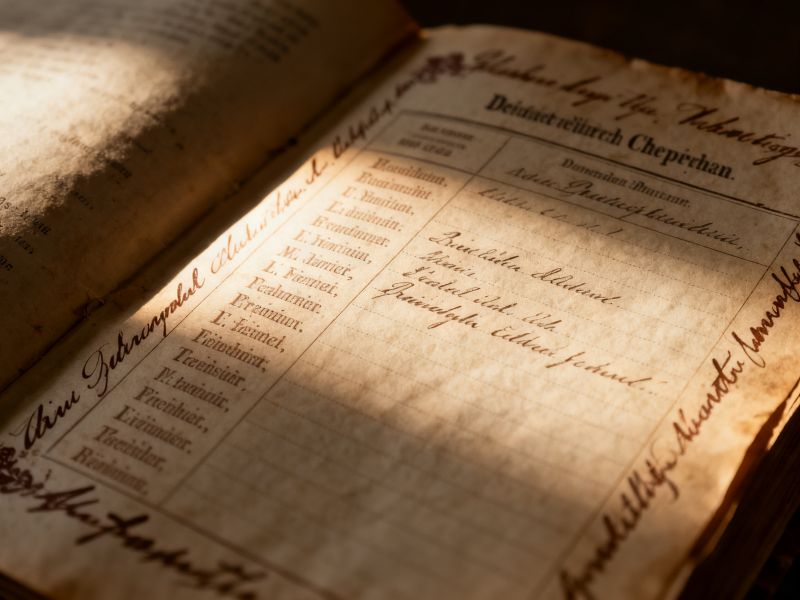
and that absence is itself informative: it points to a family line that stayed small, rural, and geographically fixed until emigration broke the pattern.Anyone pursuing Uweschler research should start with the Lippe church books。then check the Bremen and Hamburg emigration registers for the 1840s–1860s. The name’s rarity is an advantage: false positives are few, and every hit is worth chasing. I keep returning to that widow in the 1783 register. Her name, Uweschler, carried no prestige, no land, no guild membership. Yet it survived—in a marginal note, a ship list, a census line—long enough for someone in the twenty-first century to type it into a search box and wonder who she was. That persistence, more than any etymological certainty, is what makes the name worth studying.